The Attention Economy 2025: From Theory to Measurement Standards
Article
From Theory to Measurement Standards
(or how 2025 will be remembered as the pivot year for structural industry transformation)
The digital advertising landscape is undergoing a fundamental shift from traditional impression-based metrics to attention-based measurement, representing the operationalization of decades-old economic theory into actionable industry standards.
This transformation is reshaping how publishers monetize content, how advertisers evaluate campaign effectiveness, and how technology platforms enable new forms of value exchange.
The Attention Economy as Conceptual Framework
The attention economy emerged as a theoretical construct from the recognition that human attention represents a finite, scarce resource in an information-rich environment.
Psychologist and economist Herbert A. Simon first articulated this principle in 1971, observing that
"a wealth of information creates a poverty of attention"
and establishing attention scarcity as the defining constraint of the information age.
Simon's characterization framed attention not merely as a psychological phenomenon but as an economic resource subject to allocation decisions and efficiency considerations.
Michael Goldhaber subsequently democratized and expanded these concepts in the late 1990s, arguing that attention transactions would increasingly supplant financial transactions as the primary organizing principle of economic activity.
Goldhaber's formulation introduced the crucial insight that attention is inherently a zero-sum game: when one entity captures attention, it simultaneously deprives others of that same attentional capacity. This competitive dynamic creates inherent inequalities and establishes attention as a form of currency that can be accumulated, exchanged, and converted into other forms of capital.
Contemporary scholars have further refined these theoretical foundations. Claudio Celis Bueno has synthesized attention economics with Marxist political economy, examining how the commercialization of attention transforms labor, time, and power relations in cognitive capitalism.
His work establishes that the attention economy doesn't merely modify behavior but renders human attention
"calculable, predictable and hence monetizable"
through sophisticated measurement and prediction systems.
Similarly, recent research has proposed dual-stream models distinguishing between "calcified attention" (stored, retrievable focus) and "flow attention" (dynamic, real-time engagement), suggesting attention could eventually fulfill monetary functions in economic systems.
These theoretical developments provide the intellectual scaffolding for the advertising industry's practical implementation of attention measurement, transforming abstract economic concepts into quantifiable metrics and tradable assets.

IAB and MRC Attention Measurement Guidelines
The Interactive Advertising Bureau (IAB) and Media Rating Council (MRC) have collaborated to establish the first comprehensive industry framework for measuring attention, representing a critical inflection point in the attention economy's maturation.
Just published in November 2025, the IAB and MRC Attention Measurement Guidelines create a standardized foundation for consistent, comparable attention measurement across digital and cross-media environments.
Framework Architecture and Development
The guidelines emerged from a cross-industry Attention Task Force comprising over 200 experts from brands, agencies, publishers, and measurement companies.
The Task Force operates under IAB's Measurement, Addressability & Data Center (MAD Center) and includes major stakeholders such as Amazon Ads, Google, Meta, Nielsen, The Trade Desk, The Walt Disney Company, Procter & Gamble, and leading attention technology providers such as InsurAds, Adelaide, Lumen Research .
This collaborative structure ensures the framework reflects diverse perspectives while establishing common standards that enable accreditation and interoperability.
Angelina Eng IAB Vice President of Measurement, Addressability & Data Center, and Ron Pinelli, MRC Senior Vice President of Digital Research and Standards, co-lead the initiative, balancing innovation with methodological rigor.
The Task Force's work emphasizes that attention measurement should complement—not replace—existing delivery and outcome metrics, serving as a critical data point for understanding exposure and engagement beyond viewability.
Four Primary Measurement Approaches
The guidelines define four validated methodologies for capturing attention, each with distinct technical requirements and applications:
1. Data Signal-Based Measurement
This approach aggregates impression-level signals from devices, ad placements, and publisher metadata. Key metrics include time-in-view, scroll depth, audibility, interaction patterns (clicks, hovers, pauses), and screen orientation changes. Data signal methods leverage existing infrastructure through JavaScript tags, Open Measurement SDK (OM SDK), and server-to-server integrations, enabling scalable, privacy-friendly measurement without additional hardware. The approach captures both ad-related exposure metrics (viewable time, share of screen, video completion) and user-related engagement metrics (presence indicators and interaction events).
2. Visual and Audio Tracking
This methodology employs eye tracking, gaze tracking, facial coding, presence monitoring, and audio signal analysis to directly measure where and how users focus their attention. Eye-tracking technology identifies fixation points and duration, while facial coding captures micro-expressions and emotional responses. Presence monitoring detects viewer presence in shared environments like connected TV (CTV), where multiple people may view content simultaneously. These techniques provide deterministic measurement of actual attention rather than probabilistic estimation.
3. Physiological and Neurological Observations
Advanced methods track heart rate, blood pressure, skin conductance, and brain wave activity via EEG devices to measure cognitive load, emotional engagement, and memory retention. These approaches reveal deep physiological responses that indicate attention quality and depth, offering insights beyond visual or behavioral metrics. While currently limited to controlled research environments, these methods establish the biological foundations of attention that predictive models attempt to approximate at scale.
4. Panel and Survey-Based Methods
This approach combines actively measured media usage data with self-reported insights from brand health studies, focus groups, and ad effectiveness surveys. Panels provide ongoing behavioral measurement that can validate and calibrate other methodologies, while surveys capture subjective attention experiences and brand recall. When properly recruited and maintained, panels offer representative sampling for projection to larger populations.
Measurement Scope and Key Requirements
The guidelines establish minimum requirements applicable across all methodologies. Viewability and audibility standards must be met as foundational conditions, with MRC requiring sophisticated invalid traffic (SIVT) filtration and confirmation of user presence. However, the framework permits attention measurement before viewability thresholds are met, provided such metrics are clearly distinguished as non-standard diagnostic measures.
User presence validation is mandatory, incorporating inactivity rules, session cutoffs, autoplay controls, and longitudinal interaction patterns. Importantly, attention measurement focuses on persons, not devices, though individual identification and demographic assignment are not required. This privacy-conscious approach enables attention measurement in cookieless environments while maintaining methodological rigor.
The framework also mandates data quality controls, requiring empirical support for predictive models, documentation of methodological assumptions, quality control over data sources, and independent auditing for MRC accreditation. Transparency requirements include detailed disclosure of measurement techniques, data sources, limitations, and validation procedures, ensuring stakeholders can evaluate attention metrics' reliability and comparability.
Digital Advertising Industry Evolution: Roles and Relationships
The attention economy's emergence has catalyzed profound structural changes across the advertising ecosystem, transforming traditional relationships and business models. As attention becomes a measurable, tradable asset, each stakeholder's role is being fundamentally redefined.
Publishers: From Content Creators to Data and Tech Providers
Publishers have experienced the most dramatic transformation, shifting from passive inventory sellers to active attention optimizers. Historically, publishers struggled to monetize unsold inventory through ad networks that aggregated space at reduced rates.
Today, leading publishers leverage sophisticated first-party data and attention measurement to command premium pricing based on demonstrated attention quality rather than mere impressions. Dotdash Meredith, The New York Times, Hearst, and The Walt Disney Company exemplify this evolution, building advanced advertising platforms that integrate attention metrics directly into their yield optimization systems.
These publishers measure attention to both content and adjacent ads, understanding that content attention fundamentally influences ad attention. By controlling attention data, publishers can create private marketplaces (PMPs) that guarantee minimum attention thresholds, eliminating intermediaries and capturing greater value from their audiences.
The disappearance of third-party cookies has accelerated this shift, making publisher first-party data exponentially more valuable. Publishers now combine streaming viewership, website engagement, subscription patterns, and content consumption into detailed audience profiles that rival global platforms.
This data advantage is particularly potent in premium environments like Connected TV (CTV) and digital audio, where deterministic targeting based on actual viewing behavior outperforms probabilistic modeling.
Advertisers: From Reach to Attention Quality
Advertisers have evolved from purchasing reach and frequency to demanding verified attention outcomes. The attention framework enables them to distinguish between served impressions and actually noticed impressions, fundamentally changing media evaluation criteria.
Major brands including Procter & Gamble, Bayer, Best Buy, and The Coca-Cola Company (through their various media partners) have integrated attention metrics into campaign planning, optimization, and measurement.
Advertisers now use attention data to:
- Set minimum attention thresholds for inventory selection, avoiding low-attention placements that waste budget
- Optimize creative development by identifying which elements capture and sustain attention
- Correlate attention metrics with full-funnel outcomes, from brand lift to sales conversion
- Integrate attention data into media mix models (MMM) for strategic planning
This shift requires new internal capabilities, as advertisers must understand attention methodologies, evaluate measurement providers, and interpret probabilistic metrics that complement deterministic outcome data.
Agencies: From Media Buyers to Technology Consultants
Traditional media agencies have been compelled to evolve from transactional buyers to strategic technology consultants. As advertisers take control of their data and technology stacks, agencies must provide expertise in attention measurement integration, data strategy development, and privacy compliance frameworks.
Companies such as GroupM, Havas, Horizon Media or EssenceMediacom now position themselves as attention optimization specialists, helping clients navigate the complex landscape of measurement providers and methodologies. Agencies develop proprietary attention-based planning tools, negotiate attention guarantees with publishers, and design creative strategies that maximize attention capture.
This consultative role requires deeper technical knowledge than traditional media buying, as agencies must evaluate the validity of different attention signals and their correlation with client KPIs.
AdTech and MarTech: The Great Convergence
The distinction between advertising technology (AdTech) and marketing technology (MarTech) has dissolved into a unified, data-driven ecosystem. Demand-side platforms (DSPs) and sell-side platforms (SSPs) have been augmented by data management platforms (DMPs) and attention measurement vendors, creating integrated stacks that optimize for attention outcomes rather than impression delivery.
Companies such as The Trade Desk, Magnite, Mediaocean or Equativ, have incorporated attention metrics into their bidding algorithms and inventory curation, enabling buyers to target high-attention placements programmatically.
This convergence means that adtech infrastructure now serves both advertising and marketing functions, using attention data to inform everything from real-time bidding to customer journey orchestration.
Social Media Platforms: Walled Gardens Open Partially
Major platforms including Meta, TikTok, Snap Inc., LinkedIn, or Reddit, Inc. participate in the IAB Attention Task Force, signaling recognition that standardized attention measurement benefits the entire ecosystem. While these walled gardens historically restricted third-party measurement, they now seem open to collaborate on framework development while maintaining control over data access.
This partial openness reflects strategic recognition that standardized attention frameworks legitimize their measurement practices and enable advertiser confidence.
Platforms like Meta have developed internal attention metrics that broadly align with IAB standards, while maintaining proprietary methodologies that differentiate their inventory. This creates a nuanced dynamic where platforms provide transparency sufficient to build advertiser trust while preserving competitive advantages in attention optimization.
Adelaide: Behavioral Metrics and Predictive Modeling
Adelaide has developed proprietary methodologies that aggregate multiple data streams into a unified attention metric called AU (Attention Unit).
AU Methodology and Technical Architecture
Adelaide's AU metric synthesizes viewability, time-in-view, interaction patterns, and contextual signals into a single, normalized score that predicts ad efficacy. The methodology operates on the principle that attention is not binary (viewed or not viewed) but exists on a continuous spectrum influenced by multiple factors:
Primary Data Streams:
- Viewability signals: Pixel-level visibility calculations conforming to MRC viewability standards, incorporating opacity, in-viewport duration, and rendering quality
- Time-in-view metrics: Duration calculations accounting for scrolling behavior, tab switches, and user navigation patterns
- Interaction indicators: Mouse movements, clicks, hovers, keyboard input, and video player interactions that signal active cognitive engagement
- Device and contextual factors: Screen size, operating system, time of day, device type, and content adjacency that influence attention sustainability
- Audience composition: Demographic and behavioral data indicating audience receptivity and attention capacity
Predictive Model Development and Validation
Adelaide has built machine learning models that predict attention outcomes with substantial accuracy by training on historical performance data and cross-publisher engagement patterns. These models identify leading indicators of attention quality that enable real-time prediction before outcome data is available—a critical capability for media optimization.
The predictive approach allows Adelaide to:
- Score inventory before it's purchased, enabling demand-side platforms to target high-attention placements programmatically
- Identify publisher and placement combinations that systematically outperform attention benchmarks
- Segment audiences by attention propensity, matching high-attention users to premium inventory
- Develop attention benchmarks by industry vertical, media type, and creative format
Lumen Research: Eye-Tracking and Predictive Modeling
Lumen Research has pioneered the application of eye-tracking technology to digital attention measurement, combining direct physiological measurement with predictive modeling to create a deterministic foundation for attention benchmarking.
Eye-Tracking Technology and Patent Portfolio
Lumen has secured EU and US patents for its eye-tracking data collection platform, protecting proprietary technology that captures gaze data from digital advertising exposures. The platform operates through passive optical sensors that track eye movement and fixation patterns without requiring user-facing cameras or explicit consumer permission in many jurisdictions.
Core Measurement Capabilities:
- Fixation detection: Precise identification of where users look, for how long, and in what sequence
- Gaze path analysis: Mapping complete visual journeys through web pages and video content, identifying which elements capture attention and in what order
- Attention duration and depth: Distinguishing between momentary glances and sustained focus, indicating cognitive engagement depth
- Emotional response mapping: Correlating eye behavior with facial coding to identify surprise, interest, confusion, or negative reactions
- Multi-ad interactions: Tracking attention across multiple ads within a single page, measuring competitive attention dynamics and ad interference patterns
Scaling Deterministic Measurement
While eye-tracking provides deterministic measurement, its panel-based nature inherently limits scale. To address this limitation, Lumen has developed a proprietary Attention Prediction Model that uses eye-tracking observations from panel members to calibrate predictive algorithms applicable to non-panel inventory.
This approach combines the deterministic rigor of empirical eye-tracking with the scalability of predictive modeling, enabling Lumen to:
- Benchmark creative effectiveness by measuring actual attention to ads under controlled conditions
- Identify attention design principles applicable across industries and formats
- Validate other measurement methodologies against deterministic eye-tracking ground truth
- Provide advertisers with attention predictions during creative development before campaign launch
InsurAds: Live Data Signals and Real-Time Execution
InsurAds represents a unique application of attention economy principles by developing the world’s leading Attention Marketplace, connecting brands and publishers to +1.5 billion monthly active users worldwide.
It's proprietary technology platform measures, secures, and monetizes real human attention, delivering guaranteed brand outcomes at massive scale.
From Predictive Attention to Transactional Value: Signals and Infrastructure
Although samples, scores, panels already add significant value to the attention ecosystem, there is a clear diference between predictive attention models and transactional real-time execution.
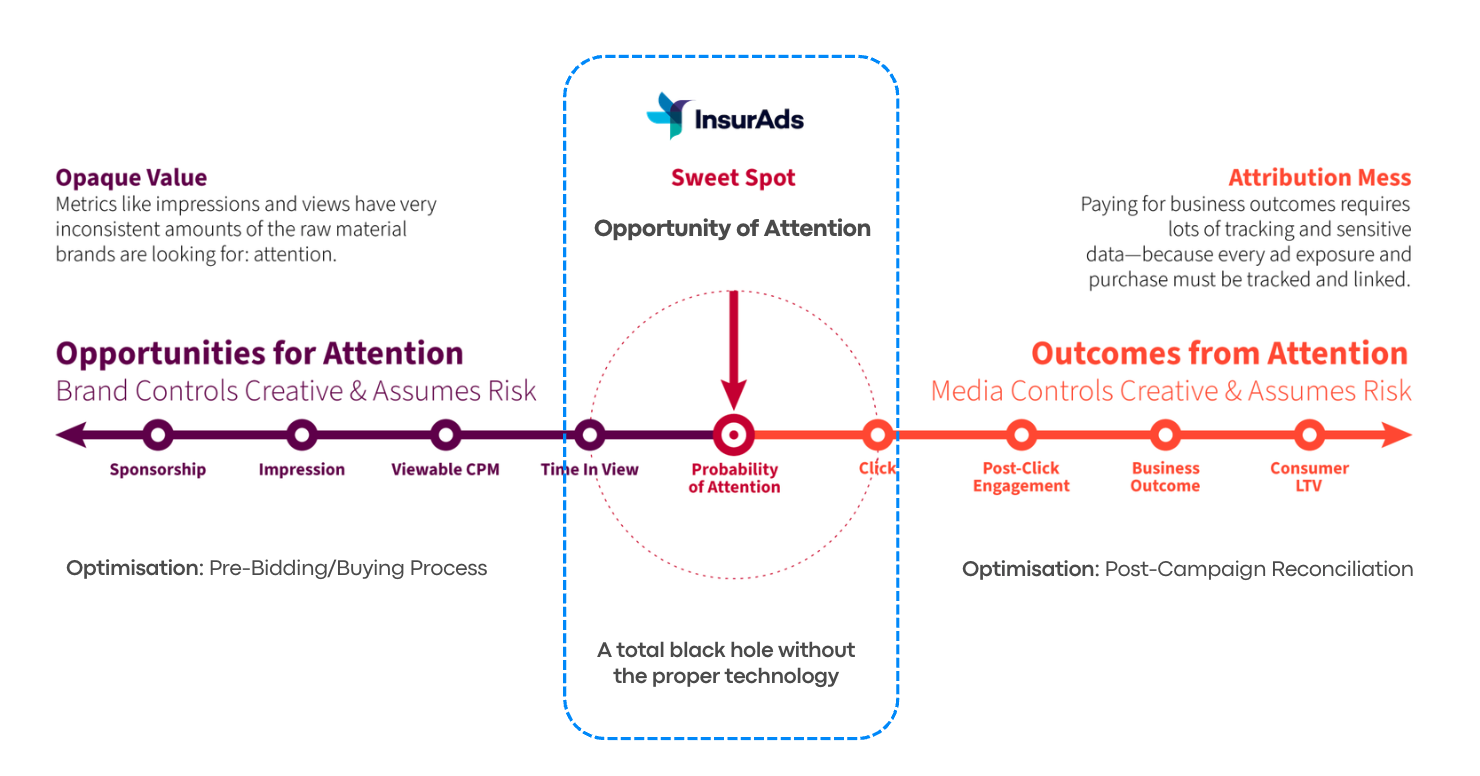
InsurAds unique positioning place it at the EXACT sweet spot for the opportunity for attention. Hence there is not an expected probability for attention but the REAL opportunity to execute on it, based on LIVE attention and context DATA SIGNALS and a BIDIRECTIONAL REAL-TIME communication infrastructure.
Core Measurement Capabilities:
- Live Bidirectional Telemetry: Establishing a millisecond-by-millisecond connection between the server and the user environment, rather than passive tracking.
- Device Health & Context: Monitoring "User Device Health Metrics" alongside standard signals to ensure the hardware environment is capable of sustaining attention.
- Cross-Dimensional Tracking: Unique capability to track attention Cross-Page, Cross-Device, and Cross-Network, resolving the identity fragmentation that plagues traditional measuring.
- User Engagement Signals: Synthesizing active inputs (scrolling, touching, mouse movement) to distinguish true cognitive presence from "zombie" pageviews.
Win-Win Attention Outcomes over Observations
InsurAds transforms how Publishers manage their audiences, unlocking the access to their real-time users and driving revenue from all user engagement. The Time and Attention Management Platform (TAMP) effectively tracks and manages all engagement time for each individual user, substantially enhancing attention viewable impressions without overwhelming the audience.
On the other hand, InsurAds revolutionizes ad spend efficiency by securing ad investment against over-exposure and under-exposure, both wasted impressions. The Marketing Assurance Warrant (MAW) leverages AI to optimize unique user attention in real-time, making sure every single impression counts, impacting substantial campaign results and clearer ROAS.
InsurAds performance and scale connects both buy-side and sell-side with world's leading Attention Marketplace, with some unique capabilities:
- Connect brands and publishers to +1.5 billion monthly active users worldwide,
- Guarantees 100% IAB Viewability, additional audience reach and +50% performance, without additional investment.
Interconnected Evolution: How Attention Economics Reshapes Industry Structure
The attention economy's formalization through IAB/MRC standards, enabled by providers like Adelaide, Lumen Research, and InsurAds, is triggering cascading structural changes throughout advertising:
Disintermediation of Value Capture
Historically, advertising networks and platforms captured disproportionate value by controlling audience access and providing measurement opacity. Attention measurement transparency enables direct publisher-advertiser relationships with independently verified attention quality, reducing the justification for intermediaries that don't add strategic value.
Publishers can now demonstrate attention quality directly to advertisers, potentially reducing dependence on DSPs and ad networks that provide only transactional services. This disintermediation particularly affects lower-quality inventory that previously commanded premium prices through bundling with high-quality placements. As advertisers differentiate inventory by attention quality, low-attention placements face pricing pressure.
Convergence of Publishing and Advertising Technology
The distinction between publisher-controlled technology (content management systems, first-party data platforms) and advertiser-controlled technology (DSPs, creative management platforms) is collapsing. Publishers increasingly operate their own demand-side optimization, while advertisers build proprietary supply-side relationships with top-tier publishers.
This convergence is visible in the evolution of programmatic platforms: The Trade Desk increasingly serves publishers seeking to optimize their supply, while Amazon Ads and Disney operate sophisticated buyer platforms despite being primarily publishers or media companies.
Industry Adoption and Practitioner Perspectives
Angelina Eng - IAB
VP Measurement, Addressability & Data Center at IAB.
Posted emphasizing the comprehensive toolkit including an RFI questionnaire for vetting partners, checklists for advertisers/agencies and publishers, and thanks Task Force co-leader Ron Pinelli (MRC) and Coalition for Innovative Media Measurement's Jon Watts and Andy Brown.
"It’s official - The IAB and MRC Attention Measurement Guidelines are now finalized! This is a major milestone for the industry — the first comprehensive framework outlining how to measure attention across digital media. Alongside the Guidelines, the CIMM and IAB Attention Measurement Playbook for Marketers is also live, helping advertisers and agencies operationalize attention metrics with practical frameworks and research-based insights".
Malcolm Devoy - PHD Media
Chief Strategy Officer at PHD Media.
At The Business of Attention event, Devoy showcased a new planning framework integrating AU to achieve effective reach, demonstrating how attention metrics reshape media planning.
"while high AU scores drive better results, the highest attention isn't always needed—just the right level for each objective".
Nicolas Grand - WPP Media
Executive Director, Research & Investment Analytics at WPP Media
Commented on Nielsen-Adelaide partnership:
"For too long, we've navigated a fragmented landscape, and this solution brings much-needed simplicity and connectivity, helping to unify disparate data points. We've consistently advocated for reframing media value beyond traditional CPMs, pushing for greater attention and engagement metrics".
Peter Naylor - Nielsen
Chief Client Officer at Nielsen
Provided long-view perspective on attention metrics:
"In the age of AI slop and MFA sites, this is something that you can point to and say, we're doing a good job to make sure your media dollars are going to places that will work the hardest for you".
Further Reading: Key Articles and Posts
- IAB and MRC finalize Attention Measurement Guidelines (Angelina Eng, Nov 2025)
- How DBAs boost low-attention media by 2.5x (Karen Nelson-Field, May 2025)
- 70% of viewable impressions never viewed (Mike Follett, Sept 2024)
- Nielsen-Adelaide partnership announcement (Marc Guldimann, Oct 2025)
- Lumen Research US patent award (Mike Follett, Apr 2025)
#InsurAds #GCPP #AttentionEconomy #AttentionMetrics #AttentionData #TimeandAttention #DigitalAdvertising #AdTech#Programmatic #PublisherRevenue #DigitalPublishing #CurationHD #ReaderRevenue #MediaMonetization #GooglePartner

InsurAds